“Stepping out of the fortress of randomness” – Entrópia Architektúra interview
Ez az interjú magyarul is olvasható.
I’d like to expand Hypogeum with more categories in the future, moving away from the blog concept toward a webzine format. The first step on this path is doing interviews. I’m happy to announce that the first one is complete, featuring the band Entrópia Architektúra whose new album ‘Kapu’ was recently released. Csaba (vocals, shakuhachi, sampler), Tamás (guitar, persian sitar, shamisen), Dani (bass, synthesizers) and Marci (vocals, iron, percussion, noise) answered my questions from among the members.
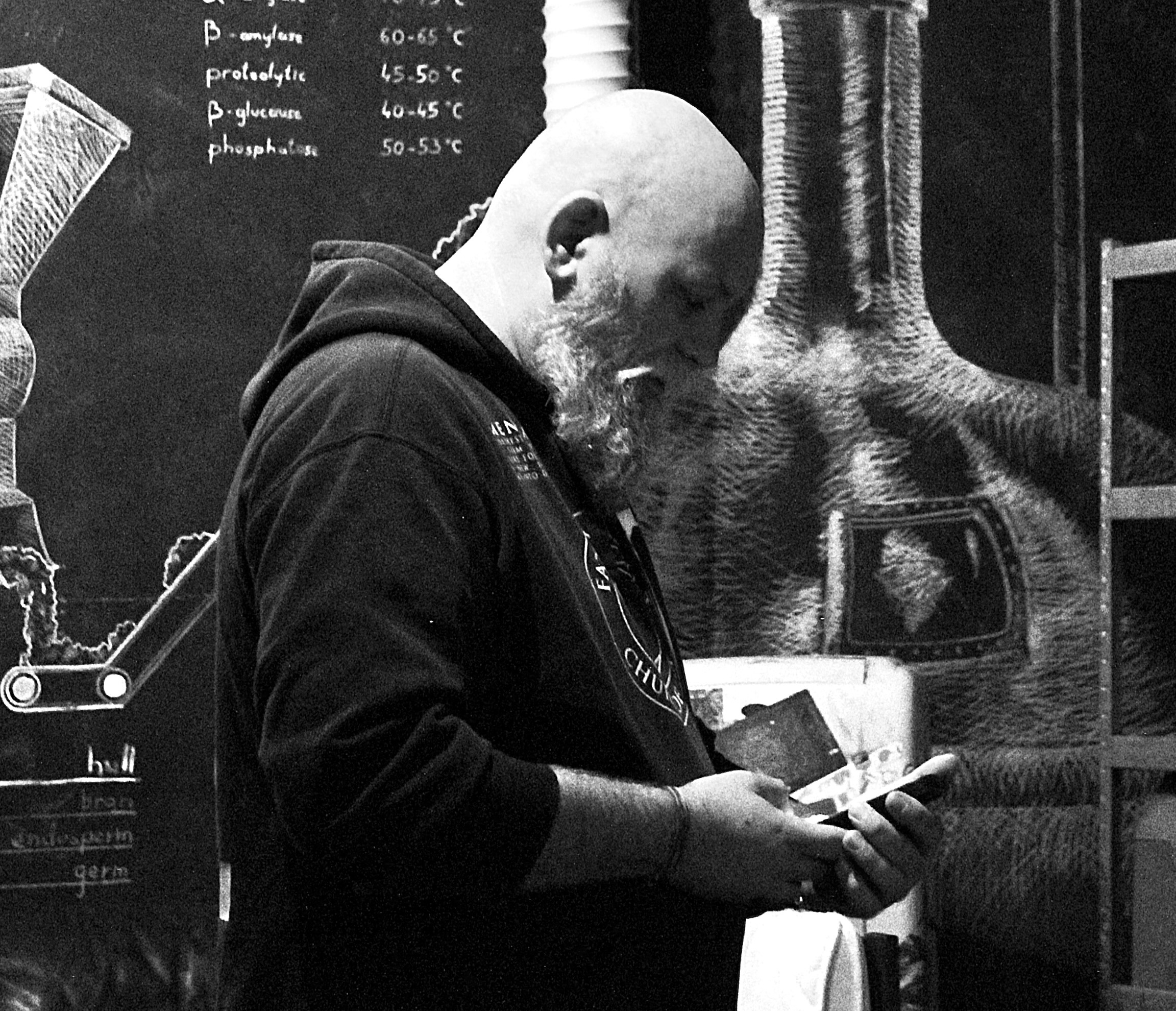
(The photos were taken on November 15th, during the pre-release listening session for the new album.)
Hypogeum: There is relatively little music material from you online. Is this a concept, or did it just happen that way?
Csaba: Both. The perception of our music is deeply tied to the present moment of the performance. We have always strived to only make material available about us in which the unrepeatability of the present and the melancholy of transience are discernible. These thoughts led us to practically sabotage the release of our own material for years.
I would label your music most accurately as “ritualistic” – a kind of modern, techno-spiritual ceremony that evokes timeless spiritual energies using contemporary tools. What is your goal in summoning these forces, what do you focus them on?
Tamás: Primarily, I want to convey strength and weight: slow-moving, yet captivating waves. I am grateful that the band was open and accepted my concept of realizing all this with an eight-string guitar, as this was not typical before I joined.
Dani: The goal is a communal experience that we create and live through together with the listeners and concert-goers. Our handling of instruments seeks to define a musical path where the tools do not necessarily follow the usual, dogmatic musical prescriptions, but rather are intended to represent a swirling musical state.
Csaba: The root of our communication method stretches back to pre-civilization times: when language was not even needed to pass on stories. It relates to the time of mystery plays and religious rites. This language without language, this form of transmission, is able to most directly channel the wide spectrum of feelings and emotions. We want our music to stop you, shock you, and give you an unforgettable experience, because it speaks partly to our exiled animal self-part, the animus and the anima. This ritualistic approach can have the strongest effect on any audience – but this requires digging down to the foundation.
Every ritual is simultaneously a regulated event that unfolds according to rules and a singular, unrepeatable occurrence. How true is this of your music? Is it more improvisational, or carefully constructed?
Tamás: The song structures and themes are fixed; minimal improvisation occurs live, mainly in the “noise” sections. Ambient guitar sounds, somewhat adorned Persian sitar themes, and the use of the suzu bell live, in the middle of “Sakura.”
Dani: We think and create in carefully constructed frameworks. The working method can be divided into several rounds, or more precisely, several different phases. The basis and structure of the movements are usually brought from home jointly with Tamás, because we both like to work alone for a long time on song structures and experiment with variations of different themes. We often review these together if we have time to meet at my studio, where we also recorded the album.
The second phase is when we arrive at the rehearsal with the complete framework and color it further together with the others – or break it down and put it back together. From then on, we have a base to which everyone adds their own ideas; we record this under rehearsal conditions. The third part is about individual refinements and roles: by this time, the track is practically ready, it “just” needs to be filled with content and our characteristic traits.
Csaba: This creative process is difficult to put into words because we approach our own music from every direction before taking it to the stage. It’s like forging a sword: from finding the ore through forging and tempering all the way to sharpening, it must go through countless operations to finally create a completely new aesthetic. On stage, however, there is no more searching, researching, or improvisation: there, the finished sword will cut.
How successful were you in reproducing the energy of your music according to your vision in the studio? How did the recording process go?
Tamás: For my part, I am completely satisfied. Miklós Nagy (“Májki”) did an excellent job, and everything went smoothly during the recording under his direction. We rarely had to tackle the same theme multiple times; the band and the studio were both prepared for it.
Dani: Creating a recording requires a different attitude and work process than a concert, and its atmosphere is completely different too. We spent a lot of time ensuring that, despite this, the essence of the band, that certain feeling that erupts at concerts, remained. We wanted a kind of living, breathing album and sound; and Májki (Miklós Nagy) fully catered to our needs and helped us with everything. We had been preparing for this collaboration for a long time: it was perfectly clear that he was the one who could realize what we wanted.
Marci: We went on a studio tour and planned where everything should be. By the time of the recording, the studio was also fully prepared for the task. We started the recording as a team, so there were no swings towards individual needs: everyone headed in one direction. This definitely gave me the experience of transforming “sterile studio work” into a shared musical experience.
Csaba: We, and the mono/mono studio, both placed great emphasis on creating the right conditions, and we managed to achieve the environment in which our creative energies “ignited.” Fortunately, the staff was very well prepared, and they managed to capture this state. During post-production, we hammered the recordings until the result was acceptable to everyone by consensus. We feel that the ritual works even on recording. What is your opinion?
Csaba, in the interview published on metal.hu, you mentioned that you were initiated into the use of the Mahakala practice, and if I am correct, both you and Marci are practicing Buddhists. What role does this tradition play in your music?
Csaba: It has a personal role. We, in our role as vocalists, breathe life into that complex and massive Golem that the instrumental team created with hard work. This deeply imbues the construction with the essence of the traditions that we take seriously and practice. I don’t want to over-mystify the role of vocalists in the band, but our voice acts as a catalyst for the forces invoked. We consider it very important to sing about things that are parts of our soul, and to be aware of their meaning from start to finish.
In the aforementioned interview, you also said, “the time and place has come for us to open a gate to a new era.” What do you hope this gate leads to exactly? And will you walk through it, or do you expect someone or something to enter your life through this gate?
Tamás: Naturally, a multi-million-dollar record deal with a major label. But turning serious: through the album, I hope for a more active presence (live performances, online reach). It is definitely a turning point, as this will finally be a reference for the band. How we move forward from this will evolve organically, through internal and external processes.
Dani: The title ‘The Gate’ musically refers to the band’s renewal. We proceeded consciously, following a concept, and by expanding our set of tools and rethinking our own musical approach, we broadened the musical world of Entrópia Architektúra, while preserving the old traditions and attitude. This is best evidenced by the movements on the album, as Gábor Nagy, Péter Martonosi, Zoltán Csürke, and József Gnáj played a large role in the creation of parts of our tracks “Achaemenid” and “93/93” years ago; although, in their current form, these tracks have been rethought in the band’s current musical perception. An important aspect of writing the album was to incorporate moods into the world of Entrópia that were not previously characteristic, as these were all within us long ago, but we were not in a musical environment where this could be realized until now. That is why we used many instruments that were not typical before.
Csaba: We are stepping out of the fortress of randomness that has characterized our work so far. The era when we could reach our audience exclusively through live performances has simply passed us by. Our music is constantly changing because it is primarily the feeling, and not the musical genre, that holds us together, motivates, and inspires us all. We have accumulated many musical elements from many different environments into this band over the years; we deconstructed these elements and then integrated them into our music. The only fixed point remained change itself, and I hope we can maintain this dynamic in the future as well. But after this, we will also erect a monument to all our subsequent steps – in an audible form.
Your music encompasses many different – traditional and modern – sounds and approaches. What is the organizing principle along which you can integrate the various influences – both individually and as a band?
Tamás: Since this is a band, when developing the sound, I primarily pay attention to ensuring that even if certain instruments have more emphasized parts, they absolutely do not overshadow the rest of the music. Every instrument and sound should be given space – even in the noisier sections. When it comes to riffs, I try to concentrate on the given theme being explicitly conducive to monotony, and that it can be repeated many times. And for folk instruments, the essence is the backdrop and the creation of atmosphere: they should act as a kind of carpet under the vocal themes.
Dani: The band has had a specific, characteristic sound world for a long time; we frame the new ideas and concepts that spring from us within this traditional framework. This is a foundation that provides direction and shapes musical innovation into its own unique image.
Csaba: The organizing principle is the band itself. As Dani mentioned, this band came to life years ago and seems to have gained independence. We just have to find the harmony of the elements we have accumulated. There is always a point where: “Ugh, this is it!”
Your music is not easily categorizable, does this cause difficulties in concert organization? Which bands would you like to perform with?
Tamás: For my part, I don’t consider the style an obstacle: broadly speaking, the production can coexist on stage with other types of music. What is more of a challenge is that the band consists of six members, and each person has to carry even multiple instruments, and then place and manage them on stage. The size of the venue is often the determining factor for the latter; I try to make my instrumental part as compact and reasonable as possible. Amplifying and coordinating them is also a serious task, requiring many channels. If I could choose, I would very gladly share the stage with, for example, Godflesh.
Dani: I don’t think the interoperability of our music’s style causes any problems at all; many people are receptive to diverse, or if you like, avant-garde musical concepts and solutions. However, since there are six of us, with lots of extra instruments, our performances have practical prerequisites that are not available at every venue. This often causes problems and, in several cases, makes the concert concretely unfeasible.
Marci: We all consume several types of music, so it naturally developed that we are more open. When people ask me what kind of music we play, I can’t categorize it either, and it’s no longer our goal. In organizing concerts, the stage size has indeed become the most determining factor. A joint concert with Neurosis would have been my dream, but that will remain just a dream.
Csaba: There are many talented and interesting players in the domestic and regional light music and experimental music niche. I personally would like to avoid performing with an artist who can be categorized in a very identical genre. It is advantageous for us and our audience if we can encompass as wide a space as possible with each concert, and even manage to pair unusual styles. Of course, this cannot be exclusive: there are exciting music festivals both domestically and regionally that select from similar genres with a relatively wide range; and we are happy to play at them and support them with our presence.
When can we see you on stage next?
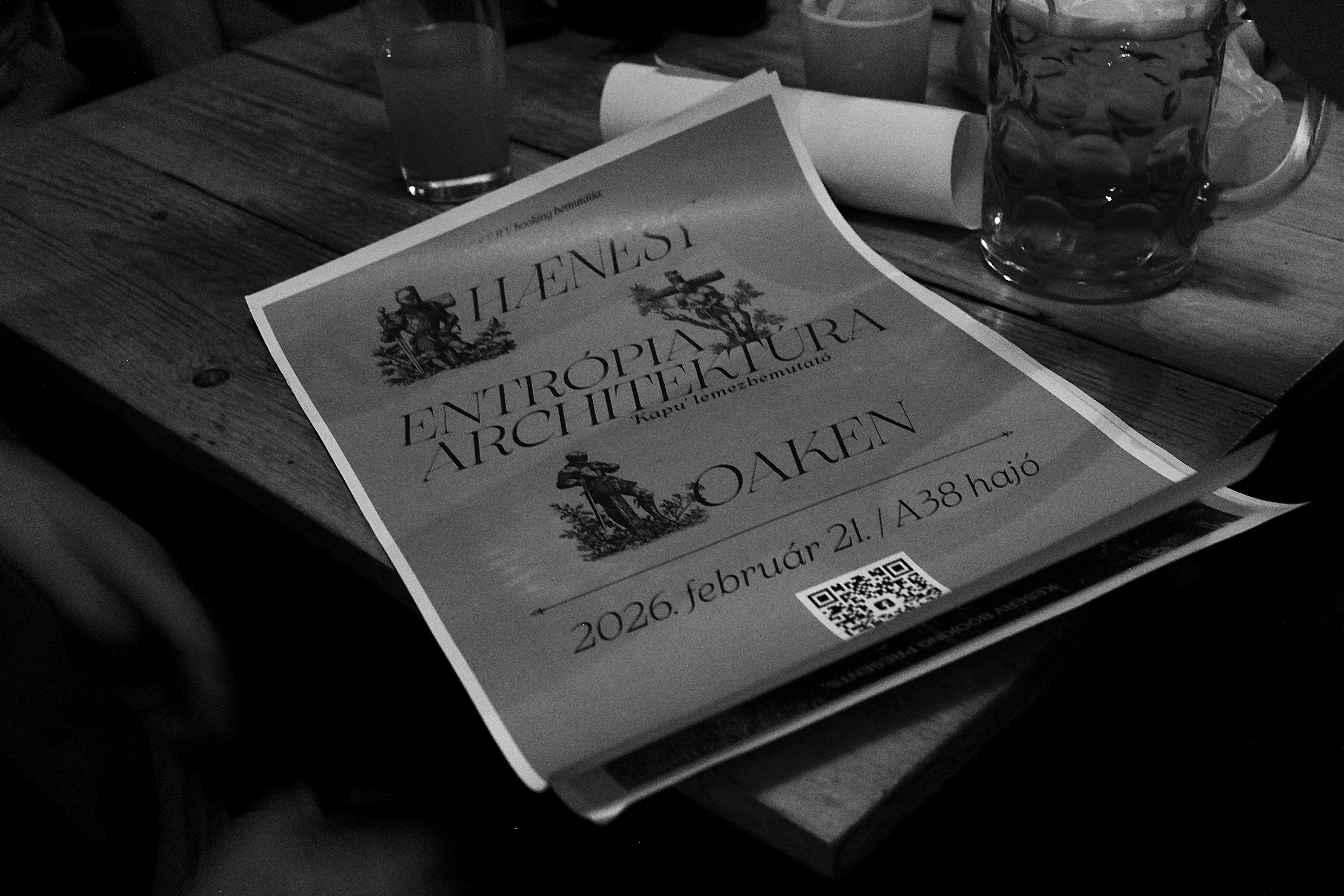
The official album launch will be on Saturday, February 21, 2026, in the belly of the A38, in the company of Hænesy and Oaken.